Responsible AI and Financial Inclusion: Insights from the AINext Conference
The conversation the industry needs to be having
Artificial intelligence is becoming increasingly embedded in financial services, from fraud detection and credit assessment to customer onboarding and risk monitoring. Its capabilities are expanding rapidly, creating new opportunities for financial institutions to improve how they operate and serve customers.
But greater speed and capability do not automatically mean progress. The more important question is whether AI is making financial services more accessible, particularly for people and businesses that traditional systems have struggled to serve.
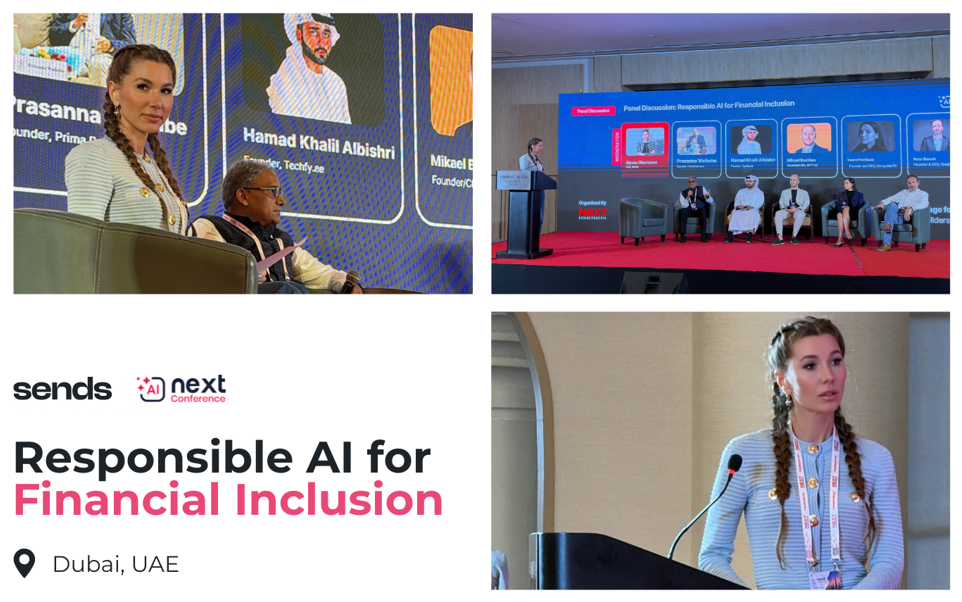
This was the focus of the panel discussion Responsible AI for Financial Inclusion at the AINext Conference in Dubai, where Alona Shevtsova, CEO of Sends, joined experts working across AI strategy, credit risk, data analytics, digital finance, regulatory oversight and strategic communications.
Together, they explored the opportunities AI creates for financial inclusion, as well as the practical challenges that must be addressed to ensure its benefits reach the people who need them.
Why AI hasn’t automatically closed the inclusion gap
One of the central themes was the gap between AI’s potential and its real-world impact.
AI can help financial institutions assess creditworthiness, improve fraud detection and identify customers who might otherwise be overlooked by traditional credit-scoring models. In principle, this could allow more people to access financial products and services.
In practice, the picture is more complicated.
Data quality is critical. AI systems depend on the information used to train and operate them, and historical financial data can reflect existing patterns of exclusion. Alternative data, including certain transaction patterns and other relevant financial indicators, can help lenders assess people with limited traditional credit histories. However, using new data sources also raises questions about privacy, consent and appropriate use.
Algorithmic bias presents another challenge. Without careful testing and ongoing monitoring, AI systems can reproduce existing inequalities rather than reduce them. And when decisions are difficult to explain, customers may struggle to understand why an application was declined or what they can do next.
The discussion highlighted an important distinction: AI can create new opportunities for financial inclusion, but those opportunities depend on how the technology is designed, trained and used.
Accountability, governance and trust
The conversation also explored what responsible AI governance looks like in practice. It needs to be more than a policy statement or a compliance exercise; it must be reflected in how financial institutions design, deploy and monitor their systems.
That means testing AI models for bias before deployment and continuing to monitor their performance once they are in use. It means explaining decisions in language customers can understand, while providing meaningful ways to question or challenge outcomes.
It also means being clear about accountability. When an AI-driven decision has a real impact on someone’s financial life, there must be a clear understanding of who is responsible and how problems will be addressed.
For financial institutions, this is not only a question of managing risk. It is also about building the confidence people need to use financial services.
Alona Shevtsova on what responsible AI requires
For Alona, the value of AI should be measured not simply by what it can automate, but by whether it helps financial institutions make better decisions and serve more people.
“AI can help financial services reach people who have been overlooked by traditional systems, but technology alone does not create financial inclusion,” said Alona Shevtsova, CEO of Sends.
“We need to look at the decisions it makes, the data behind them and the impact on real people. Innovation only has lasting value when it is fair, transparent and builds customer trust. The goal should not be to automate more decisions simply because we can, but to make better decisions and widen access responsibly.”
Her perspective reflects a broader challenge facing the financial services industry: ensuring that technological progress translates into meaningful improvements for customers.
What this means for Sends
At Sends, we believe financial services should work for the people and businesses that rely on them. As technology continues to evolve, the industry needs to look beyond what new tools can do and consider how they affect customers in practice.
That means focusing on real problems, understanding the limitations of new technologies and keeping customer needs at the centre of product development.
Financial inclusion is not achieved simply by making a service digital or a process faster. It requires solutions that are accessible, useful and supported by trust.
The conversation at AINext reinforced why these questions matter. As AI becomes a bigger part of financial services, responsible innovation will depend on combining technological capability with sound judgement, clear accountability and a focus on customer outcomes.
About Alona Shevtsova
Alona Shevtsova is CEO of Sends, a UK fintech providing personal and business financial services, including multi-currency accounts and international payment solutions.
Earlier in 2026, she received the Global FinTech Leadership Award at the FiNext Awards Dubai 2026, under the Excellence in Finance category. She was also named to the Standout 45 of Innovate Finance’s Women in FinTech Powerlist 2025, recognising women contributing to the development of the fintech industry.