
Sends team named hackathon finalists with ‘Financial Pod’
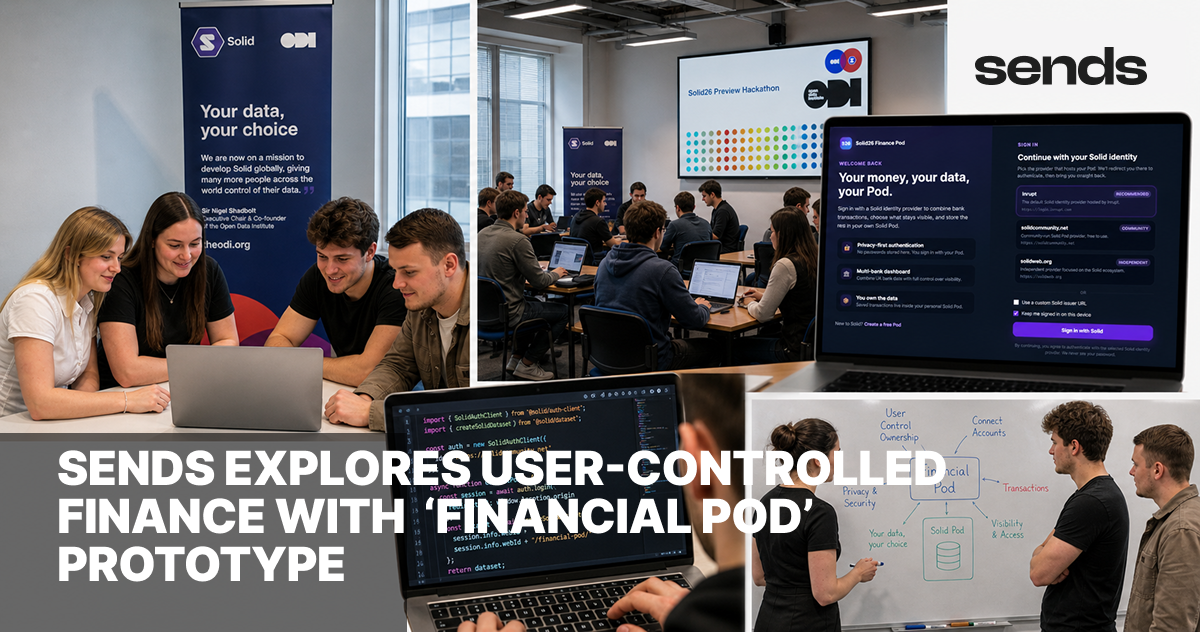
We’re proud to share that our team at Sends has been named one of three finalist teams at the Open Data Institute (ODI) hackathon, held to mark the launch of Solid26.
Over two intensive days, we joined engineers and data innovators from across the UK and beyond to explore new approaches to data ownership, privacy, and interoperability — and built a working prototype along the way.
We went into the hackathon to learn. We left as finalists.
The event formed part of the broader Solid Symposium 2026 programme led by the Open Data Institute, bringing together global experts focused on advancing user-controlled data technologies and real-world applications of Solid.
Exploring Solid — and building something new
During the hackathon, we immersed ourselves in Solid — the decentralised data framework pioneered by Tim Berners-Lee.
In simple terms, Solid separates data from applications, allowing individuals to store their personal data in secure, self-managed spaces known as Pods. This gives people direct control over what they share, with whom, and for how long.
As we explored the technology, the connection to our own approach at Sends became clear. We focus on building financial tools that are secure, simple, and designed around the user — and Solid is built on those same principles.
Introducing the Financial Pod
Building on these ideas, our team developed the Financial Pod — a prototype concept for a secure, user-owned space where people can bring together their financial data and manage it on their own terms.
The concept allows users to:
- Sign in via a Solid identity provider
- Connect financial accounts, including bank transactions
- Decide exactly what data is visible — and to whom
Rather than storing sensitive information on centralised platforms, the Financial Pod routes processed data directly into the user’s own Solid Pod. In other words, ownership stays with the individual.
At its core, the idea is simple: your money, your data, your Pod.
From concept to prototype in two days
Everything we built was created within the hackathon environment. The Financial Pod is an early-stage prototype — but one that reflects a very real direction for the future of financial services.
As with any innovation in this space, taking the concept further would require thorough regulatory review and alignment with compliance frameworks. As an FCA-authorised institution, we’re committed to ensuring that any future development meets the highest standards.
Why this matters
We see growing momentum around user-controlled data — and Solid is attracting increasing interest from developers and institutions working to build a more user-centric web.
For us, participating in the ODI hackathon was about more than just building a prototype. It was an opportunity to explore how these ideas could shape the future of financial services — with greater transparency, control, and trust for users.
What’s next
The Financial Pod is just the beginning.
We’ll continue exploring technologies like Solid that have the potential to reshape how financial services are built and experienced — always with a focus on giving users more control over their data and their financial lives.
Note: The Financial Pod is a prototype concept developed during the ODI hackathon and is not currently a Sends product. Any future development would be subject to full regulatory review.